
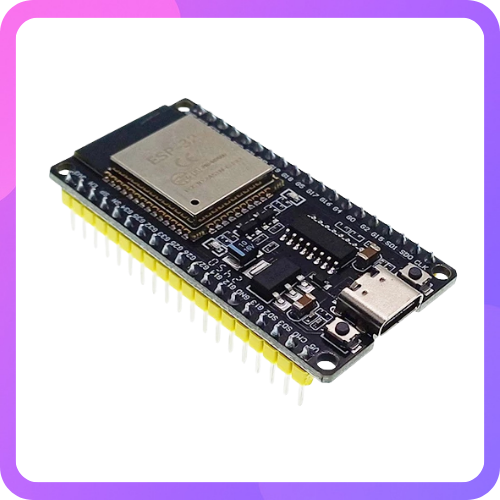
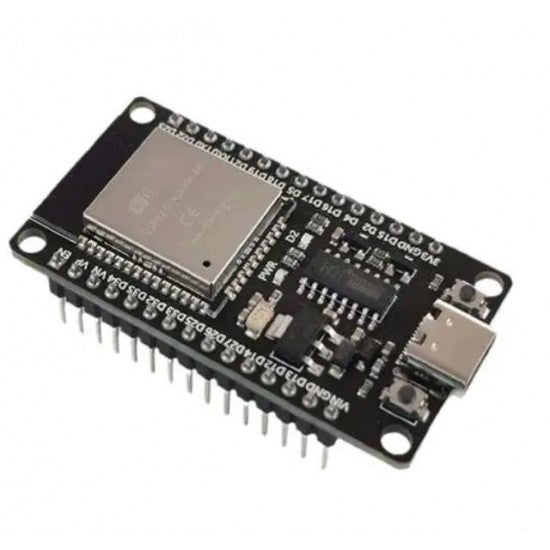
ESP32-U2 38-pin Development Board — CH340 USB Interface
ESP32-U2 38-pin Development Board — CH340 USB Interface
SKU:VT00609
Regular price
Rs. 710.00
Regular price
Rs. 390.00
Sale price
Rs. 710.00
Shipping calculated at checkout.
Quantity
86 in stock
Couldn't load pickup availability
Key Features:
- Delivering exceptional performance at an affordable price point.
- It's packed with advanced features and supports LWIP protocol and FreeRTOS.
- With a small volume, it seamlessly integrates into various products.
- Facilitates easy development through Lua programming.
- Supports three modes - Access Point (AP), Station (STA), and AP+STA.
Pin Diagram of Node MCU 38 Pins:

ESP32 to 8266 Comparison:
- ESP32 is a powerful device that runs through a 32-bit dual-core processor CPU with a clock speed of 160MHz to 240MHz while ESP8266 is a single-core CPU with a clock speed of around 80MHz.
- As we know the ESP32 has a higher speed compared to ESP8266 it consumes more power.
- ESP32 has more than 16 GPIO pins along with UART, I2C, I2S, ADC, DAC, and TWAI pins. ESP8266 also comes with 16 General Purpose Input Output (GPIO) Pins and other GPIO, UART, I2C, I2S and ADC Pins.
- ESP32 comes with Bluetooth and WIFI together onboard whereas the ESP8266 comes with only WIFI.
ESP8266 vs. ESP32
|
Features |
ESP8266 |
ESP32 |
|
Microcontroller |
Xtensa Single-core 32-bit L106 |
Xtensa Dual-Core 32-bit LX6 with 600 DMIPS |
|
Frequency (MHz) |
80 |
160 to 240 |
|
Bluetooth |
No |
Bluetooth 4.2 and BLE |
|
SRAM |
No |
Yes |
|
GPIO Pins |
17 (11 Usable Pins) |
38 (32 Usable Pins) |
|
PWM |
8 Channels |
16 Channels |
|
ADC |
10-bit |
12-bit |
|
TWAI |
No |
Yes |
|
Power Consumption |
Approx. 70.5 mA |
Approx. 80~90mA |
|
Working Temperature |
-40ºC to 125ºC |
-40ºC to 125ºC |
|
Price |
Comparatively lesser than ESP32 |
Comparatively higher than ESP8266 |
Applications:
- Universal low-power IoT sensor hub
- Home automation.
- Mesh network.
- Industrial wireless control.
- Sensor networks.
- Smart Socket.
- Wi-Fi speech recognition device.
Esp32 Development Board specifications comparison:
| Board | Processor & Cores | Wireless | Flash / RAM | GPIO Count | USB Support | Target Use |
|---|---|---|---|---|---|---|
| ESP32 NodeMCU-32 (38 Pin) | ESP32 (Dual-core Tensilica LX6) | Wi-Fi + Bluetooth 4.2 | ~4MB Flash + SRAM (module dependent) | 32+ usable | USB-UART | General IoT & Prototyping |
| ESP32 Development Board with WiFi and Bluetooth - 30 PIN | ESP32 (Dual-core) | Wi-Fi + Bluetooth | ~4MB Flash | ~30 GPIO | USB-UART | Breadboard Friendly |
| ESP-WROOM-32 ESP32 ESP-32S Development Board | ESP32-WROOM module | Wi-Fi + Bluetooth | ~4MB Flash | ~30–38 GPIO | USB-UART | Basic ESP32 Dev Board |
| Espressif ESP32 DevKitM-1 Development Board | ESP32 (Official) | Wi-Fi + Bluetooth | Configurable Flash | Official GPIO Map | USB-C | Official Espressif Dev Kit |
| ESP32-DEVKIT-IE ESP32 WiFi BLE Development Board | ESP32 | Wi-Fi + Bluetooth | Varies | Standard Headers | USB | Standard Dev Kit |
